

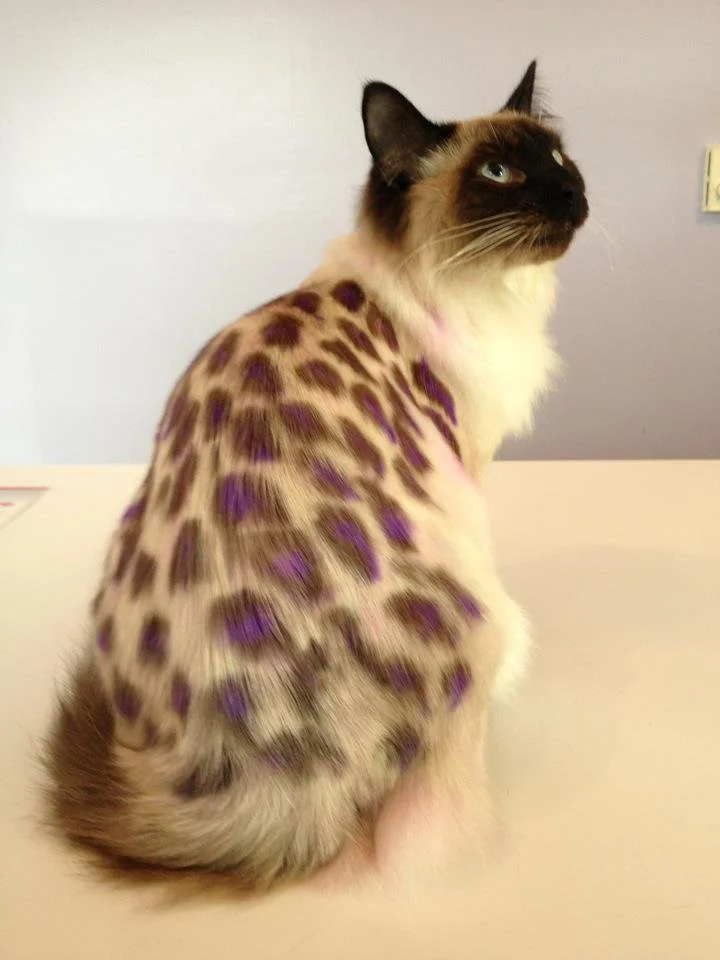
Formal Notice Regarding Bleaching (“Color Lifting”) on Live Pets
The International Association of Professional Esthetic Groomers (The IAPEG) issues this notice to formally document the known and foreseeable risks associated with the bleaching of companion animals. The IAPEG formally classifies the bleaching of dogs and cats, including practices marketed as “color lifting,” as animal endangerment.
Basis for Classification
Animal endangerment occurs when an individual or organization knowingly exposes an animal, whether by action or encouragement of, to foreseeable risk of injury, illness, or death without medical necessity or demonstrable benefit to the animal.
The bleaching of companion animals meets this definition in full.
This notice exists to clarify what educators, sponsors, and event organizers cannot plausibly claim ignorance of.
Foreseeable Injuries and Medical Risks
Bleaching agents function via oxidative chemical reactions. In dogs and cats, exposure to these substances presents documented risks including, but not limited to:
Dermal and Follicular Injury
Chemical burns (superficial to full thickness)
Delayed tissue necrosis with onset hours to days post-exposure
Permanent disruption of the epidermal barrier
Chronic dermatitis and recurrent secondary infections
Long-term coat thinning, breakage, and follicular damage
Respiratory Injury
Acute airway irritation
Bronchial inflammation
Chemical pneumonitis from inhalation of volatile compounds
Exacerbation of brachycephalic airway disease
Ocular Injury
Chemical conjunctivitis
Corneal ulceration and scarring
Permanent vision impairment or loss
Delayed inflammatory eye disease following aerosol exposure
Animals do not reliably signal early ocular injury, increasing the likelihood of irreversible damage before intervention.
Long-Term Respiratory Consequences
Development or worsening of chronic bronchitis
Increased risk of reactive airway disease
Asthma-like conditions following repeated or prolonged exposure
Reduced pulmonary resilience in aging or immunocompromised animals
Oral and Gastrointestinal Exposure
Ingestion of residues through normal grooming behavior
Oral mucosal burns
Gastrointestinal irritation and toxicity
Systemic exposure through compromised skin
Environmental and Secondary Exposure
Bleaching practices create shared environmental risk. Animals not directly treated may still suffer injury through airborne exposure. This includes animals confined in crates, holding areas, or adjacent spaces.
Secondary exposure does not eliminate responsibility.
Risk Amplifiers
Certain animals are at elevated risk of severe injury, including:
Brachycephalic breeds
Puppies and kittens
Geriatric animals
Animals with pre-existing skin, eye, or respiratory disease
Animals under stress or sedation
IAPEG Notice of Professional Responsibility and Liability
Use of Oxidative Chemicals on Live Animals
This notice serves to clarify the professional, ethical, and legal exposure associated with teaching, sponsoring, or permitting bleaching practices to be promoted on companion animals.
Foreseeability and Duty of Care
The risks outlined above are well established in veterinary dermatology, toxicology, and respiratory physiology literature. As such, injury resulting from bleaching practices is foreseeable, not accidental.
Foreseeable harm creates duty.
Duty creates responsibility.
Knowledge and Intent
Educators, sponsors, and event organizers operating within the grooming industry cannot reasonably claim ignorance of:
The chemical mechanisms involved
The biological vulnerability of dogs and cats
The existence of veterinary literature documenting injury
Continued promotion or allowance of bleaching practices after risk has been documented constitutes knowing exposure.
Misrepresentation of Safety
Marketing bleaching under alternative terminology such as “color lifting” does not alter:
The chemical mechanism
The biological response
The medical risk profile
Downplaying or reframing these risks may constitute negligent misrepresentation, particularly when instruction is provided to unassuming groomers who rely on educators and sponsors for accurate information.
Shared and Extended Liability
Responsibility for injury may extend beyond the individual teaching the service to include:
Manufacturers and sponsors promoting or supplying products
Trade show producers and venue operators allowing the promotion of bleaching on pets
Allowing a hazardous practice to occur does not shield an organization from liability. It documents awareness.
Absence of Immediate Harm Is Not Evidence of Safety
The lack of immediate catastrophic injury does not establish safety or due diligence. Many chemical injuries present delayed onset, and long-term respiratory and dermatologic damage may not become apparent until well after exposure.
Reliance on anecdotal outcomes does not meet professional or scientific standards.
Professional Credibility and Welfare Claims
Any individual or organization that teaches, sponsors, allows teaching, or promotes bleaching practices on live animals is engaging in conduct that meets the criteria for animal endangerment and cannot credibly claim alignment with:
Animal welfare principles
Evidence-based education
Veterinary or scientific consensus
The IAPEG recognizes the bleaching of dogs and cats as preventable harm imposed for cosmetic outcomes. Preventable harm imposed knowingly is not experimentation, innovation, or education. It is endangerment.
Veterinary Dermatology & Skin Barrier Damage
Miller, W. H., Griffin, C. E., & Campbell, K. L. Muller & Kirk’s Small Animal Dermatology. 8th ed. Elsevier.
Gross, T. L., Ihrke, P. J., Walder, E. J., & Affolter, V. K. Veterinary Dermatopathology. 2nd ed. Wiley-Blackwell.
Scott, D. W., & Miller, W. H. “Diseases of the Skin.” In Small Animal Clinical Diagnosis by Laboratory Methods. Elsevier.
Olivry, T., et al. “Skin Barrier Function in Dogs.” Veterinary Dermatology.
Chemical Burns & Toxicology
Riviere, J. E., & Papich, M. G. Veterinary Pharmacology and Therapeutics. 10th ed. Wiley-Blackwell.
Gupta, R. C. Veterinary Toxicology: Basic and Clinical Principles. 3rd ed. Academic Press.
ATSDR (Agency for Toxic Substances and Disease Registry). Toxicological Profile for Hydrogen Peroxide.
OECD. Guidance Document on Skin Irritation and Corrosion Testing.
Ocular Injury & Aerosol Exposure
Gelatt, K. N., Gilger, B. C., & Kern, T. J. Veterinary Ophthalmology. 6th ed. Wiley-Blackwell.
McLaughlin, S. A. “Chemical Ocular Injuries.” Veterinary Clinics of North America: Small Animal Practice.
Eaton, J. S., et al. “Ocular Surface Injury Following Chemical Exposure.” Journal of Veterinary Emergency and Critical Care.
Respiratory Injury, Inhalation, and Long-Term Lung Damage
King, L. G. Textbook of Respiratory Disease in Dogs and Cats. Elsevier.
Reinero, C. R. “Chronic Bronchitis and Reactive Airway Disease in Dogs.” Veterinary Clinics of North America.
NIOSH. Health Effects of Occupational Exposure to Oxidizing Agents.
Beasley, R., et al. “Chemical-Induced Asthma.” New England Journal of Medicine.
Percutaneous Absorption & Species Differences
Hostynek, J. J. “Factors Determining Percutaneous Absorption.” Food and Chemical Toxicology.
Monteiro-Riviere, N. A. “Comparative Skin Absorption in Animals.” Toxicologic Pathology.
Riviere, J. E. “Dermal Exposure and Absorption in Veterinary Species.” Journal of Veterinary Pharmacology and Therapeutics.
Environmental & Secondary Exposure
OSHA. Occupational Exposure to Airborne Oxidizing Agents.
WHO. Chemical Safety and Inhalation Risk in Confined Environments.
Pauluhn, J. “Repeated Inhalation Toxicity of Reactive Chemicals.” Inhalation Toxicology.